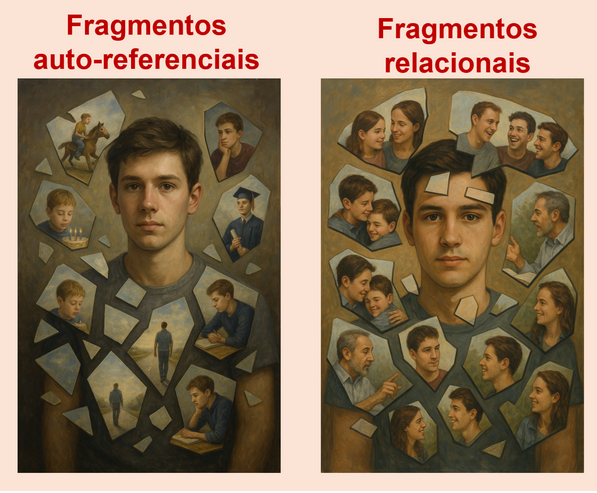
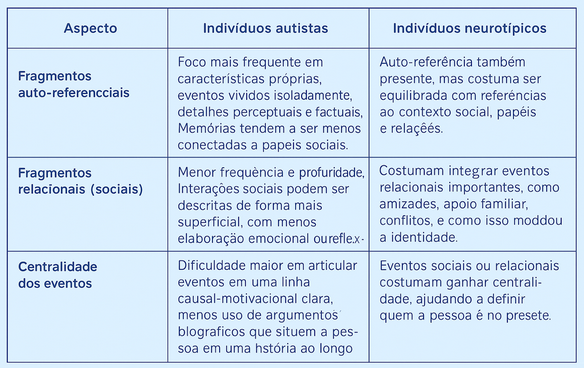
As dificuldades com a coerência global no self narrativo de indivíduos autistas têm implicações importantes para intervenções clínicas e educacionais: pode ser necessário fomentar explicitamente a exploração de narrativas relacionais e o raciocínio autobiográfico social para apoiar o desenvolvimento de um self narrativo mais integrado, flexível e adaptado a mudanças ao longo da vida. Além disso, destaca-se a importância de cautela com abordagens terapêuticas que exijam alto grau de insight autobiográfico ou reorganização narrativa complexa, dada a possível vulnerabilidade do self narrativo no autismo.
REFERÊNCIAS
Allé, M. C., et al. (2025). Narrative identity differences in autism. Scientific Reports, 15(1), 16990.
Conway, M. A. (2005). Memory and the self. Journal of Memory and Language, 53(4), 594-628.
Coutelle, R., Goltzene, M. A., Bizet, E., Schoenberger, M., Berna, F., & Danion, J. M. (2020). Self-concept clarity and autobiographical memory functions in adults with autism spectrum disorder without intellectual deficiency. Journal of autism and developmental disorders, 50, 3874-3882.
Crane, L., Goddard, L., & Pring, L. (2010). Self-defining and everyday autobiographical memories in adults with autism spectrum disorders. Journal of Autism and Developmental Disorders, 40(3), 383-391.
Frith, U., & Happé, F. (1994). Autism: Beyond “theory of mind”. Cognition, 50(1-3), 115-132.
Habermas, T. & Bluck, S. (2000). Getting a life: The emergence of the life story in adolescence. Psychological Bulletin, 126(5), 748–769.
Habermas, T. & de Silveira, C. (2008). The development of global coherence in life narratives across adolescence: Temporal, causal, and thematic aspects. Developmental Psychology, 44(3), 707–721.
McAdams, D. (2015). The art and science of personality development. New York: Guilford.
Tanweer, T., Rathbone, C. J., & Souchay, C. (2010). Autobiographical memory, autonoetic consciousness, and identity in Asperger syndrome. Neuropsychologia, 48(4), 900-908.